And here's what happened
I saw this line in the man page:
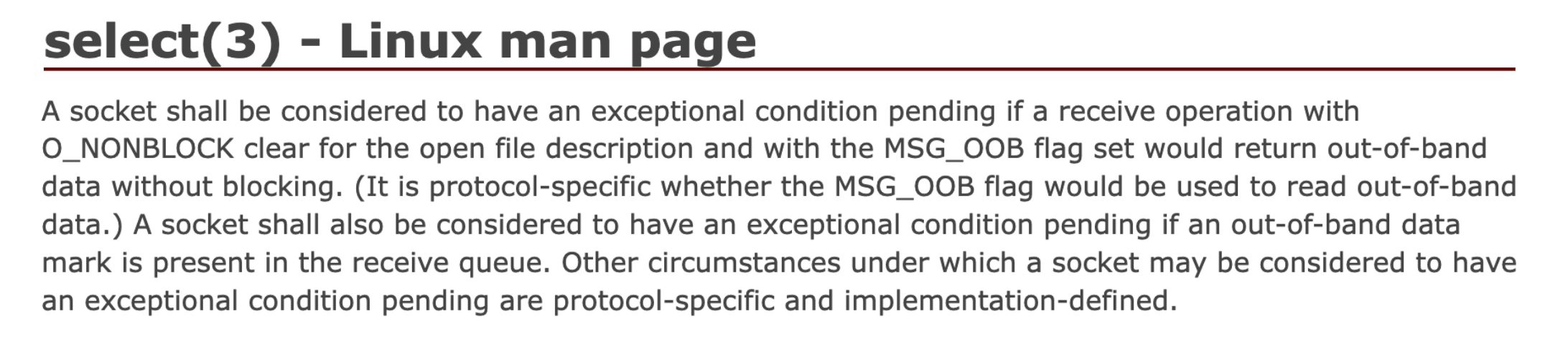
But I never saw it actually trigger. So I decided to write a tiny TCP client/server, and try to make select() wake up on the exceptfds set.
TCP’s “out-of-band” data isn’t a second stream or a priority lane. It’s just one single byte flagged as urgent. The sender sets the urgent pointer in the TCP header.
On the receiving end, two options exist:
- Default: urgent byte is only visible if you call
recv(MSG_OOB). - With
SO_OOBINLINE: urgent byte is delivered inline with the regular stream, butselect()still signals it as “exceptional.”
That’s it. One byte, not a side channel.
pseudocode:
server:
socket()
bind()
listen()

fd_set rfds, efds;
while (true) {
    FD_ZERO(&rfds); FD_ZERO(&efds);
    FD_SET(c, &rfds); FD_SET(c, &efds);

    select(c+1, &rfds, NULL, &efds, NULL);

    if (FD_ISSET(c, &efds)) {
        char b;
        int n = recv(c, &b, 1, MSG_OOB);
        printf("OOB: got '%c'\n", b);
    }
    if (FD_ISSET(c, &rfds)) {
        char buf[64];
        int n = recv(c, buf, sizeof buf, 0);
        if (n <= 0) break;
        printf("INBAND: %.*s\n", n, buf);
    }
}
client:
int s = socket(AF_INET, SOCK_STREAM, 0);
connect(s, ...);

send(s, "hello", 5, 0);
send(s, "!", 1, MSG_OOB);   // the urgent byte
send(s, "world", 5, 0);
Run the server, connect the client, and watch the logs:
INBAND: hello
OOB: got '!'
INBAND: world
Here's the thing:
- the exceptfds set was marked only when the OOB byte arrived,
- a call to
recv(MSG_OOB)returned it cleanly, and - if I had enabled
SO_OOBINLINE, thenrecv(MSG_OOB)stopped working and the ! showed up inside the normal stream—but exceptfds still got flagged.
So the man page was right: exceptfds is just “would recv(MSG_OOB) not block.”
I ran tcpdump -vv while sending. The OOB send set the TCP URG flag and advanced the urgent pointer. You can see it in the packet dump:
Flags [P.], urg 1, seq 6:7, urgptr=1
BSD vs Linux
There’s an old historical quirk: BSD stacks interpret the urgent pointer differently. On FreeBSD/macOS, the “urgent byte” is actually delivered as the last byte of the stream, not a separate one.
why it matters (or doesn’t)
In the old days, telnet used OOB for control signals. Today, hardly anything does. It’s deprecated in RFC 6093.
But as an experiment:
- i confirmed
select()’s exceptfds really does fire. - it only wakes up when there’s urgent data waiting to be
recv(MSG_OOB)’d. - it clears once consumed.
- and it’s just one byte — no queue, no stream.
and if you ever see it in production? Chances are you’re debugging legacy telnet, or something’s gone wrong.