I don't particularly like writing about cliche̐s. infact, i rank cliche̐s at the same level alongside context rot and slop. "ai is going to take all your jobs". you bozos can't do anything about it. there will be no place for junior engineers. I know, it sucks to be a junior engineer. it sucks to enter the job market in 2025. but it's not all bad. at least we now have the data to measure the damage that has been made since the first real get-shit-done chatgpt drop in 2023. this time the data is from ADP, the largest payroll software provider in the US.
the recent paper published by researchers at Stanford University, titled Canaries in the Coal Mine? Six Facts about the Recent Employment Effects of Artificial Intelligence, highlights an early warning sign of potential danger of incorporating ai into the job market. this paper lists six trend-based facts that provide large-scale evidence supporting the hypothesis that the ai revolution is beginning to have a significant and disproportionate impact on entry-level workers in the US labor market, which I've summarized here.
Fact 1. Employment for young workers has declined in AI-exposed occupations. In contrast, the trends for occupations that are rated as less exposed do not fit the pattern of the more exposed occupations (not a surprise).
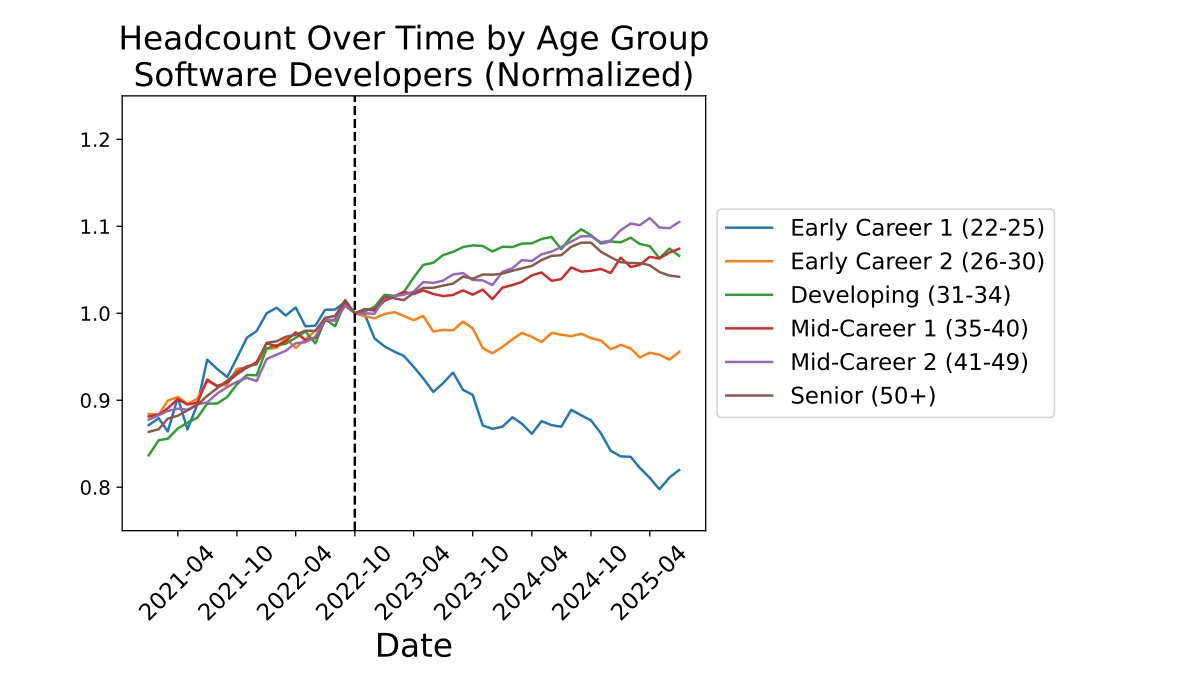
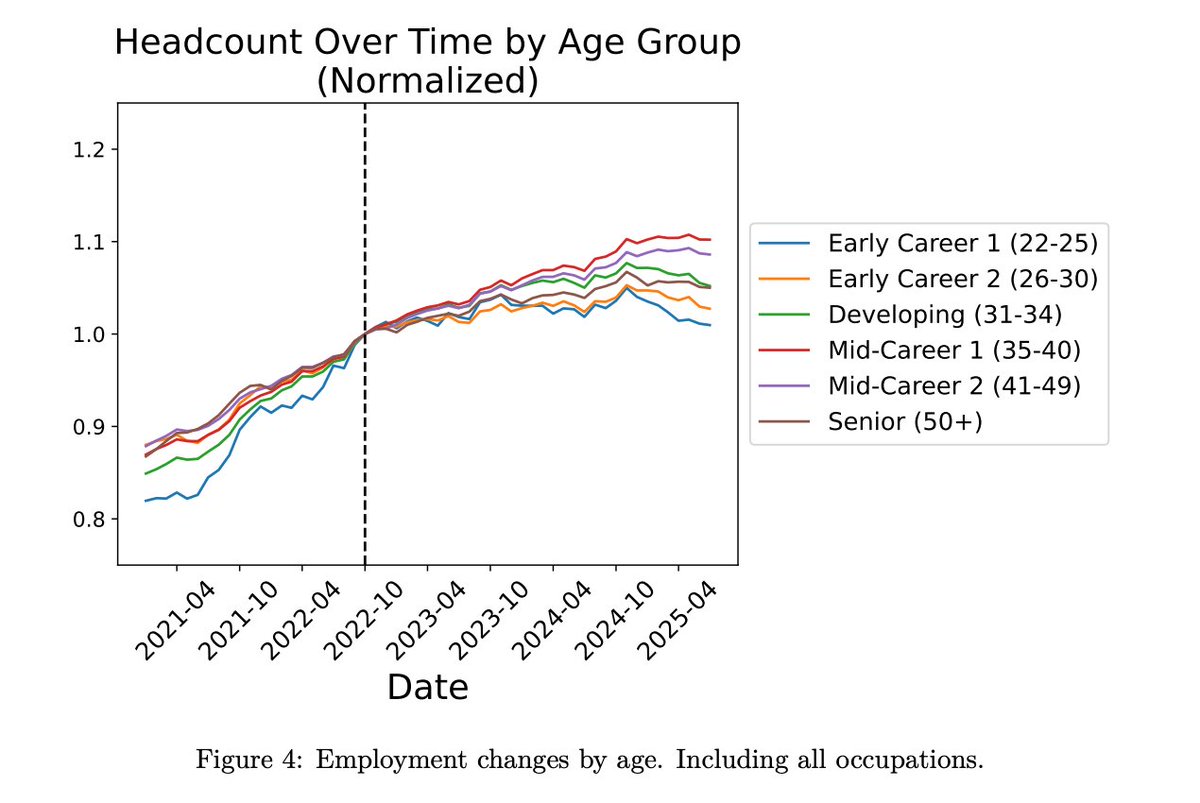
Fact 2. Though overall employment continues to grow, employment growth for young workers in particular has been stagnant.
Fact 3. Entry-level employment has declined in applications of AI that automate work, in contrast to jobs where AI complements the developers has not been effected.
Fact 4. Employment declines for young (ages 22-25), AI-exposed workers remain after conditioning on firm-time shocks. The findings imply the declines are not explained by firm-level events (such as layoffs or slowdowns across entire companies that just happen to hire AI-exposed young workers), but rather are associated directly with AI exposure in those jobs.
Fact 5. Differences in salary trends across age groups and AI exposure quintiles are minimal. In other words, while young, AI-exposed workers are more likely to lose jobs, those who stay in those roles are not seeing a substantial change (increase or decrease) in their pay.
Fact 6. Findings are largely consistent under alternative sample constructions. Effects still persist whether software or non-software devs, IT or non-IT sectors, remote or non-remote work.
This paper was a topic of discussion on a recent podcast on techwontsave.us featuring Brian Merchant — author of the book Blood in the Machine. I quote some of the podcast transcript here, which I felt kinda intersting and somewhat counterintuitive to the general discourse around ai.
the curve is more of a cascading sigmoid
The big assertion around generative AI for so long has been like it’s on this exponential curve like so many of these other tech products… but now it looks like we’re on the S‑curve… it plateaus again for a long time, until you, maybe 10 years down the road, or something, there’s this next development.
societal risks
The big thing the past couple months has really been the growing wave of stories about the mental health consequences—about people committing suicide after having talked to chatbots and gotten really concerning series of dialogue from them where they’re basically egging on their suicidal ideation.
this one is ai as control and power
Everybody should be asking themselves why it is that the one technology—the one non‑overtly military technology—that the Trump administration is interested in is AI… That’s because it’s so well suited to be a technology of control, of domination, of surveillance.
what will happen to jobs
In no way are we going to see anything like a mass‑scale jobs apocalypse. It’s not going to happen. The AI is not suited to do enough jobs. It requires too much oversight. It’s too expensive. But… there are still a lot of use cases where management can use it as a tool, use it as leverage to emiserate or, yes, sometimes even replace workers or freelancers… especially where there are workers in more precarious conditions.