With the rapid depletion of IPv4 addresses, Network Address Translation (NAT) has become an essential component of modern networks. NAT allows multiple devices to share a single public IP address, enabling secure and efficient communication between private networks and the internet.
IPv4 came out in the early 1980s
The young Internet lived in a world of mainframes
-
Many user terminals leashed to one central machine on the Internet
-
Personal microcomputers in the first generation, few modems even
-
Internet backbone ran only to advanced research facilities
Only researchers really cared about Internet resources
IPv4 uses 32-bit addresses: e.g., 134.10.2.45
- Surely 4.2B addresses are enough!
"I think there is a world market for maybe five computers." – surely apocryphal remark attributed to Thomas Watson, chairman of IBM
By the early 1990s, the Internet had grown up
Original assumptions of the Internet, defied
-
Now primarily a consumer tool, not a research tool
-
Internet became accessible through modems, then broadband and cellular
-
A clear path to billions of devices on the Internet
-
Devices are always on, always connected
-
No option other than increasing the address space
The IPng initiative
-
Undertaken by the IETF in the early 1990s (see RFC1550)
-
Led to IPv6 RFC1883 published in December 1995, mature version in RFC2460 December 1998 (What happened to IPv5, anyway? See ST-II RFC1819)
Virtues of IPv6
Plenty of addresses
-
340,282,366,920,938,463,463,374,607,431,768,211,456
-
That’s 128 bits, 340 undecillion or 3.4×1038
-
Grouped into /64s, blocks of 18 quintillion addresses
-
IPv6 fixes the network prefix at 64 bits
-
Enough addresses in a network that they can be chosen whimsically
- 2001:19f0:feee::dead:beef:cafe (freenode)
- 2001:420:80:1:c:15c0:d06:f00d (cisco)
- 2620::1c18:0:face:b00c:0:1 (facebook)
IPsec built-in from the start
- Vint often remarks this was the greatest shortcoming of IPv4
However, a new standard can’t be introduced overnight
What’s the interim strategy?
Multiplexing an IP Address
IETF created “private” address space RFC1918 (1996)
-
Most famously 10.0.0.0/8, 172.16.0.0/12, 192.168.0.0/16
-
Technically, the 172.16 block is 16 contiguous /16s, and the 192.168 block is 256 contiguous /24s
ip-masq in 1997
-
Allowed multiple computers to sit behind one modem’s Internet connection
-
Required application-layer gateway (ALG) for sophisticated features like FTP
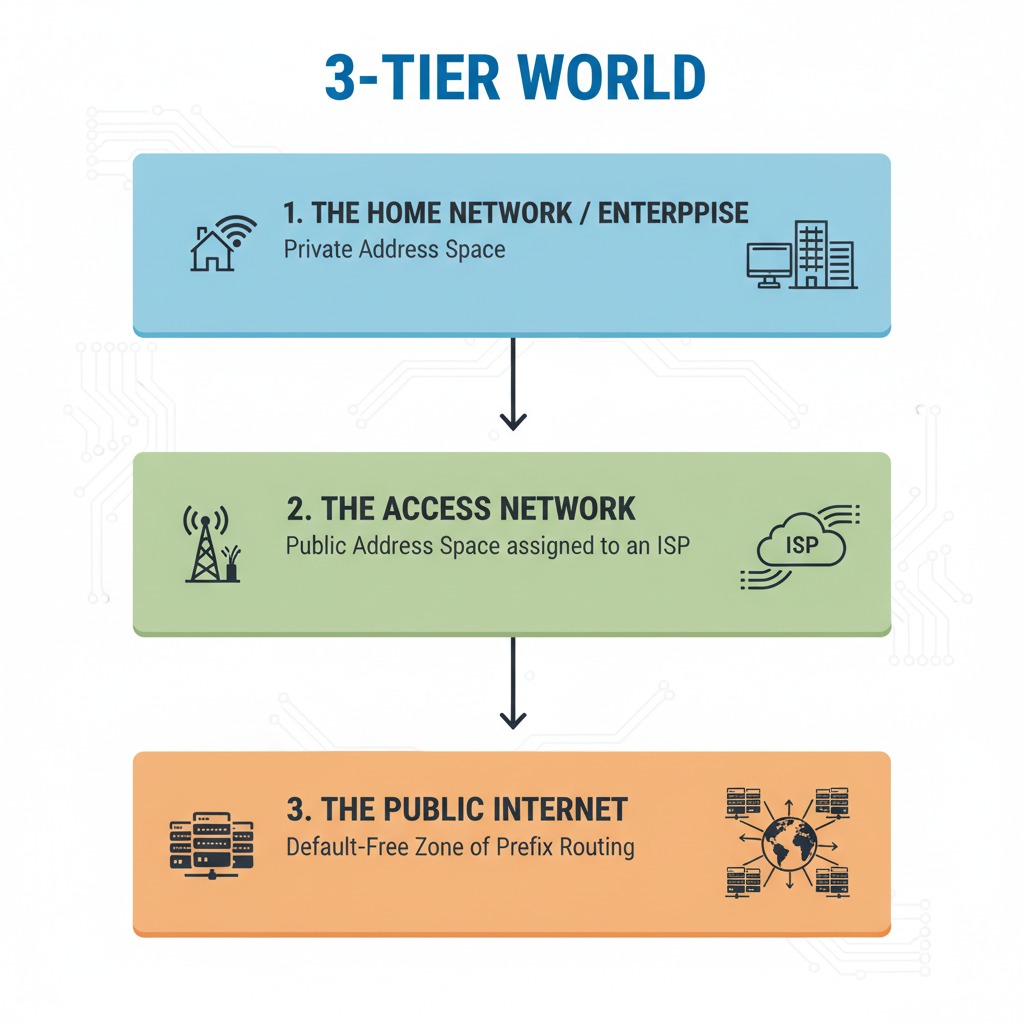
Today the ubiquitous home “router” is mostly a Network Address Translator (NAT)
-
Has one public IP address on the WAN side, maps external ports to internal
-
Private addresses served via DHCP on the WiFi/Ethernet side
-
Your computer’s IP address has a good chance of being 192.168.0.1
-
If you can’t reach DHCP, then link-local autoconfiguration (169.254.0.0/16) RFC3927
-
Implements various NAT, firewall and forwarding policies, supports many sorts of ALGs
The Dark Bargain of NAT
Work by masking the address from which packets are sent
-
The NAT effectively hides the addresses behind it
-
Effectively firewalls the private network
-
However, recipients can’t distinguish endpoints behind the NAT
NATs optimize for client-server connections
- Surfing, downloading, gaming
NATs interfere with asynchronous notifications
-
A NAT opens “pinholes” only when a client on the inside sends traffic out
-
When services on the outside want to send traffic in, you have a problem
NATs bungle rendez-vous protocols that require endpoints to know their own IP
-
A variety of workarounds have been developed to address this
-
These create real problems for peer-to-peer applications
- Skype and BitTorrent are triumphs of engineering
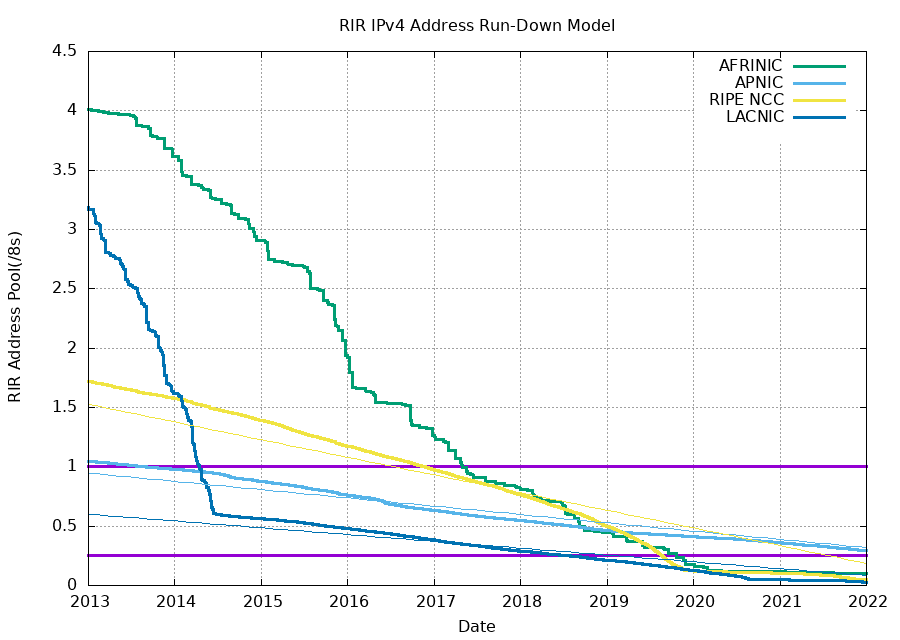
Ultimately, strict conservation and NATs merely delayed the inevitable
Final IPv4 IANA assignment rule invoked Feb 3 2011
-
At that time, the five remaining /8s held by IANA were allocated, one each, to the RIRs
-
As of April 2011, APNIC already ran out
-
RIPE ran out on September 14, 2012
-
The rest will follow in the next couple years
- Right now, ARIN & LACNIC have 3 /8s left, AFRINIC has 4